 |
|
|
|
|
|
|
Tours Bring Life To Mount Hope Cemetary
by
Camy Sorbello
|
|
|
|
|
|
|
I grew up in Rochester, N.Y. I went to school there, right through college at the University of Rochester. In fact, I still live in the area and drive to the city frequently for work and pleasure.
Yet I had never visited one of its greatest treasures — Mount Hope Cemetery, the first American Victorian municipal cemetery, dedicated in 1838.
Sure, I had passed it a bazillion times, always in a hurry, often thinking, someday I've got to check that place out. I hear it's fascinating.
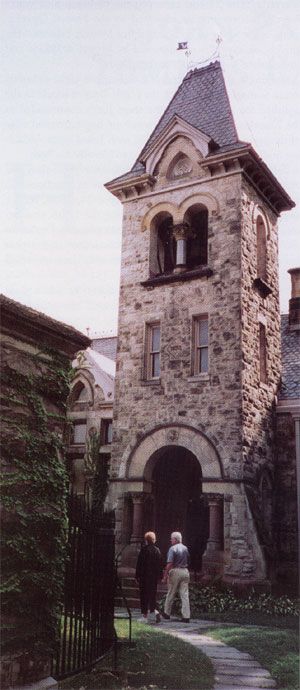
Finally, on a bright Sunday in October, I joined a group of enthusiasts at the 1874 stone gatehouse to take a free walking tour offered by a volunteer organization, the Friends of Mount Hope Cemetery.
I had convinced my father, Ange Sorbello, to come along. Like me, he had lived in or near Rochester his entire life without visiting the cemetary.
With us was Anne Stonehocker, originally from Yorkshire, England, now a resident of a nearby suburb. As a horticulturalist, she was keen on seeing the various trees and plants that shade and accent the 196-acre site.
|
|
 |
|
|
|
 |
|
Our tour guide, Nancy Uffindell, joined The Friends after taking a tour herself, years ago.
The organization, founded in 1980, helps preserve and maintain Mount Hope as well as educate tourists, local residents, and student groups about this rich cultural resource.
"I like helping other people learn and being a part of the public's education," said Uffindell, a lifelong Rochester resident. She loves the history and the natural beauty and rolling hills that make up the cemetary.
Rather than just a final resting place for the dead, it's an outdoor sculpture museum, a historical park, and an arboretum.
As a municipal cemetary, Mount Hope must depend on the city budget of Rochester for funding.
The
Friends, besides raising awareness and educating
through tours, organize specific projects,
like restoring a gazebo or stabilizing
headstones.
|
|
|
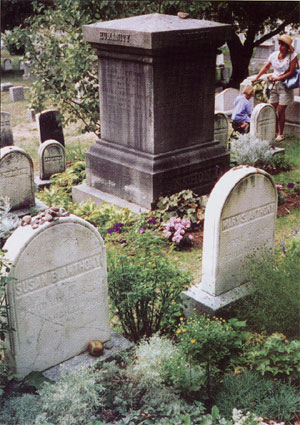
Grave of Susan B. Anthony and sister Mary
|
|
|
Warren Kling is a local historian actively involved in The Friends.
"We want people to know what a treasure they have here in Rochester," he said.
|
|
 |
|
|
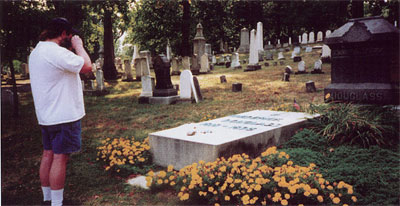
Grave of Frederick Douglass
|
|
|
|
The "adopt-a-plot" program utilizes the botanical expertise of Cornell-trained master gardeners.
"We encourage people to decide if there's a particular grave they're interested in," said Kling. "Then they can maintain it."
These horticultural improvements are expecially attractive along the walking tour route, and include general garden areas as well as specific graves.
The volunteers work for free, and donations from satisfied tour members help pay for the supplies like plants, concrete, etc.
|
|
|
|
 |
|
|
|
Uffindell, our tour guide, obviously had a passion for the beauty and history of Mount Hope, as she began the tour, taking us back to 1830s Rochester.
Once the largest city between New York and Chicago, Rochester became a boomtown after the 1825 opening of the Erie Canal. But in 1832, over 100 people died in a cholera epidemic, and the city needed a larger cemetery away from downtown.
It's hard to imagine Mount Hope as wilderness, since today it's surrounded by city. But back then, it was one and a half miles from downtown and consisted of thick woods, impenetrable swamp, and steep hills and valleys. Not everyone favored the locale.
"That ground isn't fit for pasturing rabbits," declared one Rochesterian.
Controversy continued. Some wanted the area leveled for easy access, and others thought all vegetation should be cleared to make way for exotic, introduced landscaping.
Fortunately for those of us who took the tour, city fathers showed a prescient sensitivity to natural topography and ecology unusual for that era.
Roads, now covering 14 and a half miles, were carefully placed — the prominent Indian Trail Avenue had been used by the Seneca Indians as they traveled north to Lake Ontario.
The dramatic geography was preserved along with native trees like oak, chestnut, basswood and beech.
In addition, by 1848, Rochester's Ellwanger and Barry Nursery, the world's largest at that time, donated specimen trees that still add shade and color to the cemetery today.
|
|
 |
|
|
After our brief introduction, Uffindell led us onward and upward as our tour took in the graves of many of the prominent people in history and industry buried in Mount Hope.
The Bausch and Lomb families (yes, of Ban-Ray fame) lie in a combined plot shaded by a massive weeping beech tree dating to the Ellwanger Barry plantings.
Hiram Sibley, founder of Western Union, was also instrumental in the purchase of Alaska.
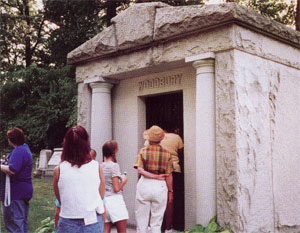
The Woodbury Mausoleum is the resting place of local collector and philanthropist Margaret Woodbury Strong. Her endowment made possible the award winning Strong Children's Museum.
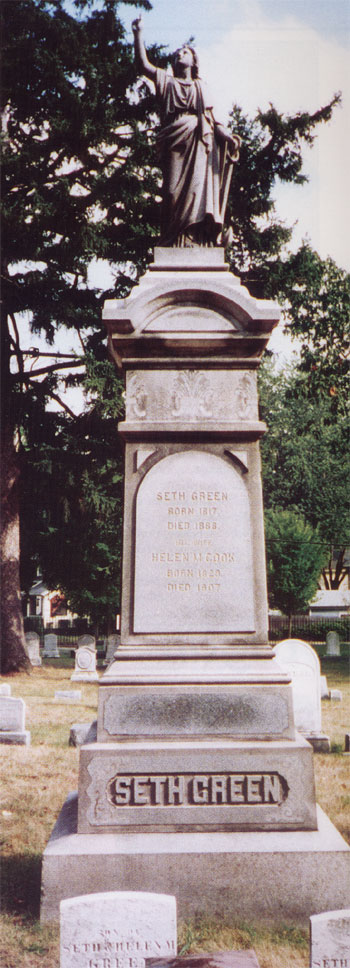
Seth Green, "the lazy boy of the Genesee," developed the system of fish hatcheries used today to stock streams and lakes. He was by trade a fish merchant.
|
|
 |
|
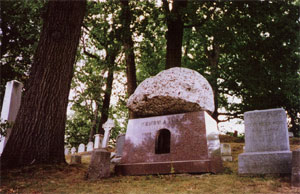
Henry Ward's monument reflects his life as the founder of Ward Scientifics and as a world-famous explorer. A red flecked rock, jasper, from Georgian Bay, rests on his grave on a hillside. Ward's life may have been adventurous, but his death was mundane. He was struck by a car in Buffalo on July 4th, 1906. |
|
|
|
Monument of Henry Ward
|
|
|
|
The tour continued uphill and down, along paved roads and weedy paths. A sense of wilderness still lingers at Mount Hope once you venture in, away from the urban streets.
"Watch out for the poison ivy," warned Uffindell at one point.
Cameras clicked when we stopped at the kettle, a circular lake left behind by receding glaciers. But for most of us, the highlight of the tour was the visit to the graves of Rochester's two most famous residents -- suffragist Susan B. Anthony and abolitionist Frederick Douglass.
Anthony, who never married, is buried beside her sister in the family plot. On the main monument are engraved the words "Liberty, Humanity, Justice, Equality."
As Quakers, the Anthonys would probably have shunned excess adornment, but the graves, maintained by the Friends of Mount Hope Cemetery, are landscaped with a variety of showy annuals and perennials. The day we visited, someone had left an apple, perhaps to honor Anthony as a teacher. Small stones rested on top of her marker, a custom signifying acknowledgement of the deceased.
Yellow marigolds surround Frederick Douglass' grave, a favorite photo stop.
A former slave and contemporary of Anthony, he published the abolitionist newspaper, the North Star, in Rochester, and worked to help slaves escape to Canada through the Underground Railroad.
As we headed back to the gatehouse, Uffindell continued to answer questions and chat with the group.
"Most everybody enjoys the tour," she said. "And the knowledge of our local area. I've had people from Europe, Asia, lots of other states — they come into town and take the tour with local residents, or on their own."
My dad was glad he'd come along. "Being a Rochesterian, I'd heard a lot about the place," he commented.
"It's all I expected and more. And I learned quite a bit about our history." He was amazed at the size of the mausoleums (the largest sleeps 20) and the diversity of the cemetery's residents.
|
|
|
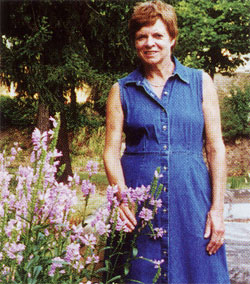
Our friend, Anne Stonehocker, said "it's interesting to see how others want to be portrayed when they're dead, some monumental, others simple."
She also found it interesting that people of any denomination, racial or ethnic group can be buried there. Mount Hope has never discriminated in any way.
"Rochester is full of historical figures," she added.
And she admired "the spectacular, magnificent old trees, thanks to Ellwanger and Barry."
|
|
 |
|
|
According to Kling, the historian, "each tour guide develops his own focus and does his own bit of research." In addition, the Friends offer theme tours, including the Civil War, famous women, horticulture, fall foliage, artists, inventors and Victorian symbolism. They are also planning a program for seniors with bus tours so they don't need to walk far.
Touring the cemetery gave my father, Stonehocker and me a new perspective on the history and influence of our area and we recommended it to others. It's trite but true -- the dead can instruct the living.
Like Pere LeChaise in Paris, or Locust Lawn in Los Angeles, Rochester's Mount Hope Cemetery serves as a tourist attraction that ties in with other key features of the area, like the Erie Canal, women's suffrage and abolition, as well as the shakers and movers of politics and industry.
And it's been right around the corner all these years.
|
|
|
|
|
|
|
|
|
|
|
|
|
|
|
|
|
|
|
|
|
|
|
|
|
|
|
|
|
|
|
|
|
|
|
|


